The Finality of Divine Guidance After the Completion of Dīn
By Admin
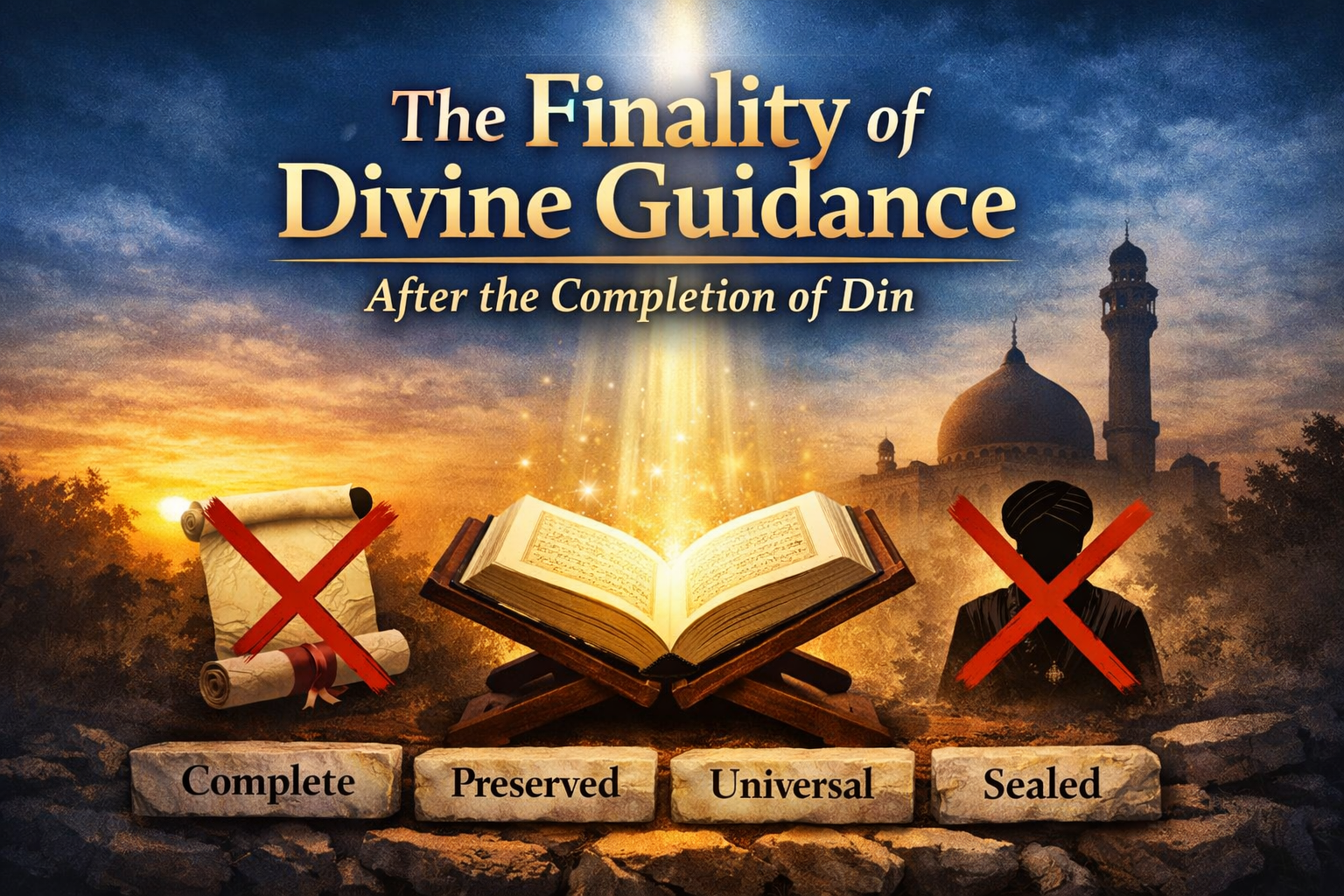
A Qur’anic and Logical Study of the Impossibility of New Prophethood
Abstract
This article presents a Qur’an-centric examination of the doctrine of completion of dīn (ikmāl al-dīn) with Surah al-Mā’idah (5:3) as its central axis. It argues that once the Qur’an declares religion to be complete, preserved, and universally sufficient, the concept of post-Qur’anic prophethood becomes not merely unsupported but logically and theologically impossible.
Using textual, semantic, and structural analysis based exclusively on the Qur’an, this study demonstrates that prophethood is a functional institution tied to revelation, and that with the completion and preservation of revelation, the institution of prophethood necessarily comes to an end. Guidance, however, continues through the preserved divine text and communal responsibility.
1. Methodology and Scope
This study adopts a Qur’an-only analytical methodology, relying exclusively on the internal coherence of the Qur’anic text. All conclusions are derived from:
-
Explicit Qur’anic statements (naṣṣ)
-
Semantic analysis of Qur’anic terminology
-
Logical consequences of Qur’anic claims
No appeal is made to hadith literature, classical tafsīr, or later theological frameworks. The aim is to determine whether the Qur’an itself allows conceptual space for prophethood after the declaration of completion.
2. Dīn in the Qur’an: A Comprehensive System of Guidance
Definition (Gloss)
In Qur’anic usage, dīn refers to a complete divine system encompassing belief, worship, ethics, law, accountability, and ultimate judgment.
Qur’anic Evidence
﴿قُلۡ إِنَّ صَلَاتِی وَنُسُكِی وَمَحۡیَایَ وَمَمَاتِی لِلَّهِ رَبِّ ٱلۡعَـٰلَمِینَ﴾
“Say: Indeed my prayer, my sacrifice, my living and my dying are for Allah, the Lord of the worlds.”
(Qur’an 6:162)
This verse establishes dīn as an all-encompassing framework governing every aspect of human existence.
The Qur’an then declares:
﴿ٱلۡیَوۡمَ أَكۡمَلۡتُ لَكُمۡ دِینَكُمۡ وَأَتۡمَمۡتُ عَلَیۡكُمۡ نِعۡمَتِی وَرَضِیتُ لَكُمُ ٱلۡإِسۡلَـٰمَ دِینࣰا﴾
“Today I have perfected for you your religion, completed My favor upon you, and approved Islam for you as religion.”
(Qur’an 5:3)
Logical implication:
If dīn is complete as a system, then no essential component of divine guidance remains pending.
3. Hidāyah (Guidance): Divine Act, Not Prophetic Authority
Definition (Gloss)
Hidāyah refers to the act of divine guidance itself, which belongs exclusively to Allah. Prophets convey guidance; they do not originate it.
Qur’anic Evidence
﴿إِنَّكَ لَا تَهۡدِی مَنۡ أَحۡبَبۡتَ وَلَـٰكِنَّ ٱللَّهَ یَهۡدِی مَن یَشَآءُ﴾
“Indeed, you do not guide whom you love, but Allah guides whom He wills.”
(Qur’an 28:56)
The Qur’an then identifies itself as the continuing source of guidance:
﴿ذَٰلِكَ ٱلۡكِتَـٰبُ لَا رَیۡبَ فِیهِ هُدࣰى لِّلۡمُتَّقِینَ﴾
“This is the Book in which there is no doubt, a guidance for the God-conscious.”
(Qur’an 2:2)
﴿إِنَّ هَـٰذَا ٱلۡقُرۡءَانَ یَهۡدِی لِلَّتِی هِیَ أَقۡوَمُ﴾
“Indeed, this Qur’an guides to what is most upright.”
(Qur’an 17:9)
Conclusion:
Guidance continues without prophets because it is anchored in a preserved text, not in prophetic presence.
4. Waḥy (Revelation): Completion and Preservation
Definition (Gloss)
Waḥy is binding divine communication that establishes religious authority. In the Qur’an, prophethood is inseparable from waḥy.
Completion of Revelation
﴿وَتَمَّتۡ كَلِمَتُ رَبِّكَ صِدۡقࣰا وَعَدۡلࣰاۚ لَا مُبَدِّلَ لِكَلِمَـٰتِهِۦ﴾
“The Word of your Lord has been completed in truth and justice; none can change His words.”
(Qur’an 6:115)
Preservation of Revelation
﴿إِنَّا نَحۡنُ نَزَّلۡنَا ٱلذِّكۡرَ وَإِنَّا لَهُۥ لَحَـٰفِظُونَ﴾
“Indeed, We have sent down the Reminder, and surely We are its Guardian.”
(Qur’an 15:9)
Together, these verses establish a closed epistemic system. No new binding revelation is possible without contradicting the Qur’an itself.
5. Prophethood (Nabī / Rasūl) as a Functional Institution
Definition (Gloss)
In the Qur’an, prophethood is a mission-based office, not a spiritual rank or evolving status.
Qur’anic Evidence
﴿مَّا عَلَى ٱلرَّسُولِ إِلَّا ٱلۡبَلَـٰغُ﴾
“The Messenger’s duty is only to convey.”
(Qur’an 5:99)
With revelation complete, the defining function of prophethood ends. Hence the Qur’an states:
﴿مَّا كَانَ مُحَمَّدٌ أَبَآ أَحَدࣲ مِّن رِّجَالِكُمۡ وَلَـٰكِن رَّسُولَ ٱللَّهِ وَخَاتَمَ ٱلنَّبِیِّـۧنَ﴾
“Muḥammad is not the father of any of your men, but the Messenger of Allah and the Seal of the Prophets.”
(Qur’an 33:40)
This sealing is structural, not symbolic.
6. The Logical Redundancy of Post-Qur’anic Prophethood
Any claim of a new prophet after the Qur’an faces an unavoidable dilemma:
-
If the new prophet adds nothing essential → prophethood becomes redundant
-
If the new prophet adds something essential → the religion was not complete
Both options contradict Qur’an 5:3. No third option exists within the Qur’anic framework.
7. Moral Decline and Reform Without New Prophets
The Qur’an anticipates moral decline yet assigns reformative responsibility to the community:
﴿كُنتُمۡ خَیۡرَ أُمَّةٍ أُخۡرِجَتۡ لِلنَّاسِ تَأۡمُرُونَ بِٱلۡمَعۡرُوفِ وَتَنۡهَوۡنَ عَنِ ٱلۡمُنكَرِ﴾
“You are the best community brought forth for humanity: you enjoin what is right and forbid what is wrong.”
(Qur’an 3:110)
The Qur’anic model of reform is post-prophetic by design.
8. Universality of the Qur’an and Closure of Future Messengership
Earlier prophets were sent repeatedly because revelation was local and temporally limited. The Qur’an removes this condition:
﴿وَأُوحِیَ إِلَيَّ هَـٰذَا ٱلۡقُرۡءَانُ لِأُنذِرَكُم بِهِۦ وَمَنۢ بَلَغَ﴾
“This Qur’an has been revealed to me so that I may warn you with it and whoever it reaches.”
(Qur’an 6:19)
The phrase “whoever it reaches” extends the Qur’an’s authority indefinitely.
9. Final Logical Verdict
The Qur’an simultaneously affirms:
-
Completion of religion (5:3)
-
Completion of revelation (6:115)
-
Preservation of revelation (15:9)
-
Universality of guidance (6:19)
-
Sealing of prophethood (33:40)
Any claim of post-Qur’anic prophethood negates one or more of these truths and therefore collapses the Qur’an’s internal coherence.
Conclusion
Within the Qur’anic worldview, prophethood was a means, not an end. Once divine guidance reached its final, preserved, and universal form in the Qur’an, the institution of prophethood necessarily came to an end.
Guidance did not cease.
Revelation did not disappear.
What ended was mediation—because it was no longer needed.
Thus, the concept of new prophethood after the completion of dīn is logically, structurally, and theologically impossible according to the Qur’an itself.